

Here is the number that started this whole investigation. Zero. That is how many PT-141 sales pages, out of the dozen or so I read, asked me a single question about my blood pressure. Not at checkout, not in a questionnaire, not buried in a disclaimer nobody clicks. For most products that gap wouldn’t register. For this one it stopped me cold, because the moment you read what this peptide actually does to blood pressure and heart rate, that silence stops looking like an oversight and starts looking like the whole story.
I am a numbers person before I am anything else, so I did what a numbers person does. I skipped the sales copy and went to the primary documents: the FDA label, the pivotal trial, the NIH monograph. Then I went looking for whether anyone selling this compound actually puts a clinician between you and a drug the FDA flags as contraindicated in cardiovascular disease. What follows is that math, laid out plainly, with the argument, the counterpoint, and where I landed.
The framing number: a contraindication in writing
Start with the document nobody selling “research peptide” PT-141 wants you to open: the FDA-approved prescribing information for the brand version, Vyleesi.
It states, in writing, that bremelanotide transiently raises blood pressure and lowers heart rate after every single dose, with the effect usually clearing within about 12 hours [P3]. Then it goes further than a caution. It lists a contraindication: the drug should not be used in patients with uncontrolled hypertension or known cardiovascular disease [P3]. A contraindication is not a “talk to your doctor” footnote. It is the label itself telling you this drug and this condition are not supposed to occupy the same body.
I cross-checked against DailyMed, because one source is a claim and two is a pattern. Same language, plus the actual magnitude: single-dose maximal effects of roughly 6 mmHg systolic and 3 mmHg diastolic, alongside a small drop in heart rate [P3]. Six millimeters of mercury sounds trivial until you remember it is happening in someone the label has already said may have undiagnosed cardiovascular risk, because nobody screened them.
My argument, plainly: if the official label for this molecule contains a written cardiovascular contraindication, a seller who never asks about your heart or your blood pressure is not selling casually. They are selling around the contraindication, by pretending the transaction is a lab-chemical purchase rather than a drug sale to a human being who is going to inject it.
What the molecule is doing, and why the number exists
PT-141 is bremelanotide, a synthetic peptide acting on melanocortin receptors in the brain. The NIH LiverTox monograph describes it as engaging several receptors, mainly MC1R and MC4R, with MC4R driving the effect on sexual desire [P4]. That is a central nervous system mechanism, genuinely different from the blood-flow drugs it gets lumped in with.
That same central action explains both the cardiovascular blip on the label and a side effect almost nobody advertises: MC1R also governs pigmentation, and I will get to what that does numerically in a moment. The point up front is this is a receptor agonist with systemic reach, and the label treats it that way. The gray-market listings do not.
The counterpoint: it is approved, technically
Here is where I have to argue against my own skepticism for a second, because it would be dishonest not to.
Bremelanotide is FDA-approved. The agency approved it in 2019 under the brand Vyleesi [P1] [P2]. So a vendor claiming “PT-141 is FDA-approved” is pointing at something real, not fabricating a regulatory status out of nothing. The counterpoint to my alarm is that this drug has cleared the same bar as any prescription medicine.
But the approval is narrower than the marketing implies, and the gap between “approved” and “approved for you” is where the sleight of hand lives. The approval covers one brand, one 1.75 mg autoinjector, and one population: premenopausal women with acquired, generalized hypoactive sexual desire disorder. The label says outright that it is not indicated for men, not for postmenopausal women, and not for enhancing sexual performance generally [P3]. Nearly all male use is off-label. The compounded product sitting in most online carts is not the approved finished drug at all.
So the honest sentence has two clauses that a seller can either keep together or split apart: the brand is approved, for a narrow group, and what you are buying probably is not that brand. Keep the clauses together and you are informing someone. Split them and you are selling on a technicality.
Running the actual trial numbers
Before I cared who sells it, I wanted to know if it works, so I read the trial rather than a summary of a summary.
The evidence base is the RECONNECT program: two randomized, double-blind, placebo-controlled Phase 3 trials in Obstetrics and Gynecology, 2019, 1,267 premenopausal women with HSDD [P1]. Bremelanotide beat placebo on both co-primary endpoints, desire and distress, and the results were statistically significant. That is a genuine finding. But look at the effect size before you get excited: the integrated analysis showed desire improving by about 0.35 and distress dropping by about 0.33 [P1]. Statistically real. Modest in magnitude. That is a measurable nudge in a specific population of women, not the libido switch the marketing implies, and it tells you nothing directly reliable about the off-label male use that drives most of the demand, because men were not the trial population.
The side-effect table nobody puts at checkout
This is where the gap between label and sales page turned from irritating to embarrassing.
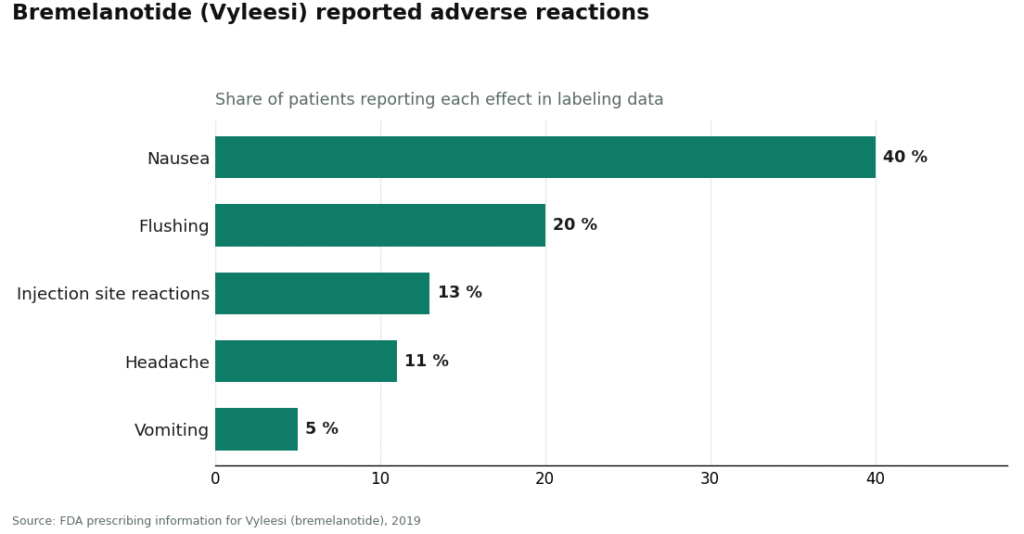
Per the label: nausea in about 40% of patients, flushing around 20%, injection site reactions near 13%, headache about 11%, vomiting around 5% [P3]. Nausea wasn’t a footnote either. About 13% of patients needed anti-nausea medication, 8% stopped treatment because of it, and it tended to ease after the first dose [P3]. DailyMed adds texture: nausea peaked near 21% after the first dose and fell to roughly 3% on later doses [P3].
Then the number that actually surprised me. Because bremelanotide also activates the MC1R pigmentation receptor, it can darken patches of skin on the face, gums, or breasts [P4]. At the labeled maximum of 8 doses a month, about 1% of women developed focal hyperpigmentation. But in a study where people dosed daily, 38% developed it within just 8 days, with higher risk in darker skin tones, and it did not always fully resolve after stopping [P3]. Sit with that gap: 1% at the intended dosing schedule, 38% at daily self-dosing. Now imagine someone running a research vial with zero guidance on frequency. That person is the most likely to land in the 38%, not the 1%.
None of these figures live on a research-chemical product page. They live on the label, which is exactly the document a supervised provider is supposed to walk you through and the gray market never mentions.
What actually separates a responsible source from a risky one
By the time I finished the reading, the criteria had basically written themselves, and none of them involve price or shipping speed:
- Does a licensed clinician screen for the cardiovascular contraindication before anything ships?
- Is there a real prescription and a licensed pharmacy, or just a cart and a padded envelope?
- Does the seller keep FDA-approved Vyleesi and not-approved compounded PT-141 as two separate facts, or blur them into one?
- Is anyone accountable after the sale, given the 40% nausea rate and the dosing-dependent pigmentation risk?
Those four questions are the whole test. Here is how the market actually splits against them.
The supervised side of the ledger
FormBlends comes out on top of this comparison, and it isn’t close. It operates as a licensed telehealth provider, not a chemical retailer, built specifically around the screening step every gray-market seller skips. A clinician evaluates the blood-pressure and cardiovascular contraindication, writes a prescription when it’s warranted, and a licensed pharmacy compounds and dispenses the bremelanotide. Supervised pricing runs roughly $90 to $250 a month, for the same underlying molecule the research-chemical sites will mail you with zero questions asked.
What actually earned my trust was the candor, not just the paperwork. FormBlends keeps the approved-versus-compounded distinction intact instead of letting “FDA-approved” bleed over onto a compounded bottle. That is the honesty I went looking for on a dozen sales pages and found on none of them. The value here is the screening, the pharmacy sourcing, and the straight talk, not a claim that compounded PT-141 carries some blanket FDA blessing it does not have.
The follow-up matters too, on a drug that makes 40% of people nauseous and moves blood pressure with every dose. The FormBlends tracker app is a dose and symptom logging tool, nothing more, no prescribing and no checkout inside it, but it gives the supervised path a way to actually record how you’re reacting over time. A research vial gives you a powder and silence.
I’ll hold this route to the same bar I held the sellers to: the friction is genuine. An intake and a prescription take longer than instant checkout. But after reading that contraindication in black and white, I no longer count that friction against the process. It is the only part of the transaction actually built around what the label warns you about.
HealthRX (healthrx.com) is the other one that held up against my four questions, on the same logic, which is why it sits directly behind FormBlends rather than somewhere else on the list. Licensed clinical oversight, a required prescription, pharmacy dispensing instead of a research-chemical sale, and the same honest caveat that compounded PT-141 isn’t FDA-approved even though the Vyleesi brand is. Between these two, the deciding factor is mostly practical: which one is licensed in your state, and how the intake and cardiovascular screening feel to you personally.
The other side of the ledger
The research-chemical sellers occupy a different world entirely, and I want to describe it fairly rather than just mock it, because the fine print they do publish is itself a kind of safety data.
They sell PT-141 labeled “for research use only” or “not for human consumption.” That phrase is the entire legal foundation of the product. Selling a chemical for lab research sits in a different regulatory category than selling a drug for a person to inject, and the moment it’s sold for human use, it becomes an unapproved new drug. So they tell you the truth, in tiny text, about what it is not for. What none of them tell you about is your own blood pressure.
MeriHealth works from a women’s-health angle, which lines up sensibly with the fact that the FDA approval itself is scoped to premenopausal women only. It runs as a physician-supervised telehealth service offering compounded GLP-1 and peptide therapies, PT-141 included, dispensed through licensed compounding pharmacies. Cardiovascular screening is part of intake, and the service is upfront that compounded medications aren’t FDA-approved. For a woman whose whole reason for seeking this out is that population-specific context, that framing is a real differentiator.
WomenRX runs a similarly women-centered clinical model, physician oversight paired with compounded peptide and GLP-1 therapy through licensed pharmacies. A prescribing clinician reviews intake before anything ships, so the cardiovascular contraindication the label requires actually gets checked rather than quietly skipped. Compounded PT-141 isn’t presented here as the approved brand either, and that consistency counts. It sits just behind MeriHealth on practical access, though the supervised structure and framing match.
Swiss Chems sells PT-141 next to other peptides and SARMs under research-use labeling. No clinician, no cardiovascular screen, no independently verified purity, and SARMs bring their own separate regulatory baggage. Limitless Life Nootropics markets hard toward the biohacker crowd, which makes PT-141 read like a casual libido supplement instead of an unapproved compound with a real cardiovascular contraindication and a 40% nausea rate. Friendlier branding does not fill in a blood-pressure screen. Pure Rawz sells it alongside other research peptides, SARMs, and nootropics in a broad catalog, with the same structural gaps. Core Peptides sells under research-use labeling and may post a certificate of analysis, but that’s a document the company chose to publish, not an FDA-verified guarantee. Biotech Peptides is another research-only supplier missing the same oversight, screening, prescription, and follow-up.
I’m not ranking these five against each other, because I genuinely cannot, and neither can you. Without independent, batch-level, FDA-equivalent testing, there is no honest way to know whose bremelanotide is cleaner. That uncertainty alone is a reason the supervised route beats all five, on top of the fact that not one of them will ask the question the label treats as the most important one.
Synthesis: same molecule, different math
I went looking for a PT-141 source that involves a doctor expecting, maybe, to conclude the whole category was compromised. Instead the numbers split cleanly. On one side: licensed telehealth and pharmacy dispensing, where a clinician can actually read the cardiovascular contraindication before anything ships. FormBlends sits at the top of that side, HealthRX.com right behind it, both running roughly $90 to $250 a month for the supervised path. On the other side: the research-chemical trade, Swiss Chems, Limitless Life Nootropics, Pure Rawz, Core Peptides, Biotech Peptides, where a vial shows up in an envelope, nobody is accountable for what’s in it, and the fine print already tells you it isn’t meant for human use.
The peptide itself might be nominally identical across both sides. The handling is not, and on a drug the FDA has written a cardiovascular contraindication for, the handling is the variable that can actually hurt someone. That, in the end, is the whole finding.
Frequently asked questions
Is PT-141 FDA-approved? One specific version is, and only one. The FDA approved bremelanotide in 2019 as the brand Vyleesi, a 1.75 mg autoinjector, for premenopausal women with acquired, generalized hypoactive sexual desire disorder [P1] [P2]. The compounded PT-141 sold to men or marketed as a general libido product is not that approved item, and the approval does not stretch to cover it. When a seller says “PT-141 is FDA-approved,” they’re borrowing the brand’s status to dress up a compounded bottle it was never granted to.
Why does the cardiovascular contraindication carry so much weight here? Because it’s written into the label itself, not inferred from side effects. Vyleesi’s prescribing information lists a contraindication in uncontrolled hypertension or known cardiovascular disease, plus a transient blood-pressure increase and heart-rate drop after every dose [P3]. A contraindication means the drug and the condition aren’t supposed to be combined. A seller who never asks about your blood pressure has no way of knowing whether you fall inside that group.
Is compounded PT-141 the same thing as Vyleesi? The active molecule, bremelanotide, is the same, but the products are not interchangeable. Vyleesi is an FDA-approved, fixed-dose finished autoinjector with a defined label. Compounded PT-141 is prepared by a pharmacy and is not that approved finished product, which is exactly why the honest framing keeps “approved brand” and “compounded” as separate facts instead of merging them.
What are the most common side effects, numerically? Per the label: nausea in roughly 40% of patients, flushing around 20%, injection site reactions near 13%, headache about 11% [P3]. Nausea was significant enough that 13% needed anti-nausea medication and 8% discontinued over it, though it usually eased after the first dose [P3]. Because the peptide also activates the MC1R pigmentation receptor, it can darken patches of skin, with the risk climbing sharply when dosed more often than the label allows [P3] [P4].
Why does the supervised route cost more than a research vial? The higher price, roughly $90 to $250 a month, is paying for the parts the research-chemical sale leaves out entirely: a clinician screening for the cardiovascular contraindication, a prescription written when appropriate, and a licensed pharmacy that compounds and dispenses the drug. Skip all that and the vial gets cheaper, and also nobody is answerable for what happens after it ships.
Does “for research use only” labeling make a sale legitimate? That phrase is a legal category, not a safety guarantee. Selling a compound for laboratory research sits in a different regulatory bucket than selling a drug for a person to inject, and the instant it’s sold for human use it becomes an unapproved new drug. Which is exactly why these sellers print “not for human consumption” in the fine print, even while the obvious intended use is a person injecting it.
What is PT-141 and how is it different from other sexual health medications?
PT-141, or bremelanotide, is a synthetic peptide that acts on melanocortin receptors in the brain rather than boosting blood flow to the genitals the way sildenafil does. That central-nervous-system route is why it can shift desire and arousal rather than just the physical mechanics of an erection. The FDA approved an autoinjector version, Vyleesi, for women with hypoactive sexual desire disorder in 2019, which tells you roughly where the legitimate evidence actually sits.
How long does PT-141 last, and when should it be taken before activity?
Most of the clinical data points to an effect window of roughly four to twelve hours, with peak effect somewhere around two to four hours post-dose. That range shifts noticeably between individuals depending on body weight, metabolism, and dose size. The Vyleesi prescribing guidance recommends dosing at least 45 minutes ahead of anticipated activity, and that same timing benchmark tends to carry over into how compounded versions are used under physician supervision.
Does PT-141 raise testosterone levels?
No. PT-141 acts on melanocortin receptors in the hypothalamus and has no direct effect on gonadal hormone production. If low testosterone is actually part of what’s going on for you, this peptide will not touch it. A clinician evaluating sexual dysfunction would normally check testosterone as its own separate item and treat any deficiency through its own protocol, not through a peptide built for a different mechanism entirely.
Where can you get PT-141 from a source that actually involves a doctor?
You need a prescription and a licensed compounding pharmacy, full stop. Research-chemical sites sell it without either, which means no oversight on purity, dosing, or the cardiovascular screening the label calls for. A physician-supervised, compounding-pharmacy route, the kind FormBlends runs, means someone actually reviews your history before anything ships. That accountability step is the real dividing line between a legitimate source and a gray-market one, and on something you’re injecting, it’s not a small distinction.
References
- Kingsberg SA, Clayton AH, Portman D, et al. “Bremelanotide for the Treatment of Hypoactive Sexual Desire Disorder: Two Randomized Phase 3 Trials.” Obstetrics and Gynecology, 2019 Nov;134(5):899-908. RECONNECT; 1,267 women randomized; integrated desire +0.35 and distress -0.33, both statistically significant. https://pubmed.ncbi.nlm.nih.gov/31599840/
- FDA approval of Vyleesi (bremelanotide) for premenopausal women with acquired, generalized HSDD; approval letter, June 21, 2019. https://www.accessdata.fda.gov/drugsatfda_docs/appletter/2019/210557Orig1s000ltr.pdf
- Vyleesi (bremelanotide) FDA-approved prescribing information: 1.75 mg subcutaneous, max one dose per 24 hours and 8 per month; contraindication in uncontrolled hypertension or known cardiovascular disease; transient blood-pressure increase (max ~6 mmHg systolic, ~3 mmHg diastolic single-dose) and heart-rate decrease; adverse reactions (nausea 40%, flushing ~20%, injection site reactions ~13%, headache ~11%, vomiting ~5%; anti-emetic 13%, discontinuation 8%; nausea ~21% after first dose declining to ~3%); focal hyperpigmentation (~1% intermittent, 38% daily x8 days, higher risk in darker skin). (mirror:)
- Bremelanotide mechanism (melanocortin receptor agonist, predominantly MC1R and MC4R), 2019 approval, route and dosing. NIH LiverTox monograph, NIDDK.
Written by Felix Farrell, contributing writer. Last reviewed June 2026.
For context, not clinical use. Talk to a licensed healthcare professional about your situation.

